
What does “privacy-first” actually mean when a mobile wallet promises Tor, hardware isolation, and Monero support? That sharp question helps cut through marketing and reveals the friction points that decide whether your coins stay private in practice — not just on paper. This article walks through a real-world case: a privacy-focused user in the United States who wants a single, usable wallet for Monero (XMR), Haven (XHV), Bitcoin (BTC) and a handful of other coins. I’ll show the mechanisms that matter, the trade-offs you’ll face, and a practical checklist to pick and operate a secure wallet.
Short answer up front: a wallet that is open-source, non-custodial, hardware-friendly, and network-aware — with options like Tor-only networking, subaddresses for Monero, and device-level encryption — gives the best real-world privacy posture. Below I use those criteria to evaluate the operational strengths and the gaps you must manage. The goal is not to evangelize a product but to explain what each architectural choice buys you and where operational discipline still matters.
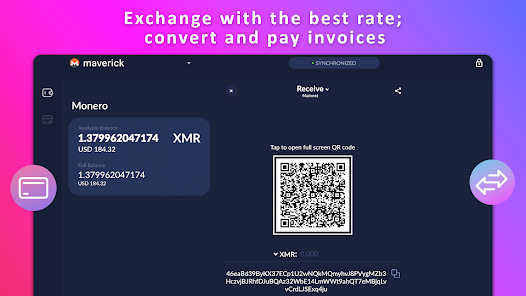
Mechanisms that deliver usable privacy (and why they matter)
Privacy isn’t a single toggle. It’s a stack of independent protections that, when combined, reduce the several channels through which sensitive information leaks: network telemetry, key custody, transaction graph analysis, and device compromise. The wallet architecture in this case study combines multiple mechanisms that map directly to those channels:
– Network-level anonymity: Tor-only mode and I2P proxy support hide your IP/address from the nodes you query. This materially reduces the ability of a network observer to link your transactions to your device — an important feature for US users concerned about ISP or corporate surveillance. The additional option to connect to custom, user-selected nodes further reduces dependence on third-party infrastructure.
– Local key protection: Encrypting wallet data with device hardware (Secure Enclave on iOS, TPM on Android) and protecting access via PIN or biometrics reduces on-device theft risk. This is not foolproof — a compromised OS or sophisticated physical attack can still extract secrets — but it raises the technical bar significantly for attackers.
– Non-custodial, open-source design: If private keys never leave your device and all client code is auditable, you avoid server-side custody risk and hidden telemetry. Practically, that means your operational privacy depends on your device and the network choices you make rather than a company’s backend.
Case constraints: Monero, Haven (XHV), and Bitcoin in one wallet
Supporting multiple privacy-focused coins introduces complexity. Monero and Bitcoin represent different privacy trade-offs: Monero is private by default (ring signatures, stealth addresses), whereas Bitcoin is transparent and requires protocol-level techniques (CoinJoin, PayJoin, UTXO control) to approach similar levels of unlinkability. A useful multi-currency wallet must therefore provide coin-specific tools rather than a one-size-fits-all setting.
Example: for Monero the meaningful features are subaddresses, background sync, and ensuring the private view key never leaves the device. Subaddresses allow unique receiving addresses per payer without linking back to the same account on-chain; background sync keeps your balance current without revealing the view key externally. For Bitcoin, privacy relies on careful UTXO selection, batching, PayJoin v2, and tools like Silent Payments. A wallet that supports both families and exposes appropriate controls lets a user practice proper hygiene for each chain.
Haven (XHV) sits near Monero in design philosophy — it aims to extend private economics to synthetic assets — but supporting it in the same UX requires the wallet to manage different consensus rules and potentially different synchronization and node requirements. The practical takeaway: multi-currency convenience is valuable, but it increases the surface area for bugs and misconfiguration. That’s why hardware integration (Ledger/Cupcake) and non-telemetry policies matter: they limit what a compromised mobile app can leak.
Where things break: known limitations and operational risks
Every security stack has blind spots. Here are the concrete, non-abstract failure modes to watch for:
– Migration limitations (Zcash example): some coins have incompatible seed or address handling across wallet implementations. A known limitation is that migrating Zcash from certain wallets requires manual transfers because seed phrase compatibility and change-address handling differ. Practically, this means migrations can leak metadata and require temporary custody exposure during transfer. The lesson: never assume an automated migration will preserve privacy.
– Network correlation risk despite Tor/I2P: Tor-only mode reduces IP exposure, but it doesn’t make you invisible. Exit node timing, application-level leaks (e.g., DNS requests not routed through Tor), or deanonymizing network traffic patterns can still correlate activity. Regularly verify that the wallet is using the intended network transport and consider combining Tor with custom node connections.
– Device compromise: hardware-backed encryption and biometrics raise the cost of extraction but do not eliminate it. A targeted attacker with root-level access, or physical access in specialized forensic labs, can still extract keys. Air-gapped workflows (Cupcake) mitigate this but at the expense of convenience.
Trade-offs: convenience vs. provable separation of risk
The most secure setup is rarely the most usable. Air-gapped hardware wallets and manual coin transfers preserve privacy but hurt everyday utility: swapping XMR for BTC or moving small amounts becomes friction-heavy. Conversely, built-in swapping (even if routed via decentralized NEAR Intents that find competitive market-maker routes) improves user experience but requires trusting that the routing and order flow don’t expose metadata you care about. The practical heuristic: split usage by intent. Use a hot multi-currency wallet for low-value, high-frequency trade and a segregated hardware-backed storage for amounts where privacy or custody risk matters most.
NEAR Intents for cross-chain swaps is a valuable mechanism: it automates decentralized routing to competitive makers without centralized intermediaries. But remember that cross-chain activity itself creates linkage across asset ledgers — the swap sequence and timing can be correlated. If privacy is the central goal, prefer batched, intentionally delayed, or split swaps to increase uncertainty for chain-analysis heuristics.
Operational checklist for a privacy-first US user
Here is a practical, reusable framework to manage the common trade-offs:
1) Separate wallets by role: hot wallet for day-to-day swaps and receipts; cold (air-gapped) wallet for savings. Use hardware integration to sign high-value transactions. 2) Network hygiene: use Tor-only or I2P, verify node endpoints, and disable any background services that might leak DNS or telemetry. 3) Key hygiene: back up seed phrases securely offline; never enter seeds on an unknown device. 4) Coin-specific behavior: for Monero, use subaddresses and never export the private view key; for Bitcoin, enable PayJoin v2 and UTXO control. 5) Migration caution: when migrating coins like ZEC, expect manual transfers and plan for temporary privacy loss.
This checklist is deliberately conservative; apply elements according to threat model and convenience tolerance.
What to watch next
Three developments would materially change these recommendations: wider adoption of wallet-level air-gap UX that’s user-friendly, standardization of seed phrase and change-address handling across wallets (reducing migration friction), and improvements in decentralized routing that better hide swap correlations. Monitor engineering progress in hardware wallet UX and any announcements about node federation changes or privacy-protocol upgrades for Bitcoin and Litecoin (e.g., MWEB adoption). These are not certainties; they are signals you can track that will alter the convenience/privacy trade-offs.
FAQ
Is Tor-only networking enough to guarantee anonymity?
No. Tor-only networking reduces IP-based linking but does not eliminate other correlation channels such as timing analysis, application-layer leaks, or cross-chain transaction linkage. Combine Tor with custom node selection, strict app permission controls, and transaction-level privacy practices (subaddresses for XMR, PayJoin for BTC) to strengthen anonymity.
Should I trust built-in swaps that use NEAR Intents?
NEAR Intents automates decentralized routing across market makers, which reduces reliance on centralized exchanges. It improves convenience and can reduce counterparty risk, but cross-chain swaps still create linkage patterns. For strong operational privacy, split large swaps, use staggered timing, or perform swaps via a cold-signed, air-gapped workflow.
How does hardware integration (Ledger, Cupcake) change my threat model?
Hardware signing reduces exposure to malware on the primary device because private keys never leave the hardware. Air-gapped solutions like Cupcake add an extra layer by isolating signing devices entirely. The trade-off is complexity and slower daily operations; for high-value holdings it’s generally worth it.
What do I need to know about Zcash migration issues?
Some wallets handle change addresses differently, so seed compatibility is not guaranteed. When migrating Zcash from certain legacy wallets, expect to manually transfer funds into a freshly created wallet address rather than relying on seed import — plan transfers carefully to avoid accidental exposure or loss.
For readers who want a hands-on starting point that combines multi-currency convenience with the privacy features discussed here, consider tools that are open-source, non-custodial, and offer hardware integration and network anonymity options. One such implementation with multi-platform support and the features described above is available at cake wallet. Use the checklist provided to match the wallet’s capabilities to your operational needs: convenience, privacy, and the level of risk you can accept.